Recently in Violent Crimes Category

May 16, 2013

Lawrence Massachusetts Man Arrested For Assault With Intent to Murder Allegedly Committed In Haverhill

Just a few days ago police found Learde Rodriguez at an apartment on Lowell Street in Lawrence, Massachusetts. The twenty-three year old was arrested in connection with a shooting alleged to have occurred in Haverhill, Massachusetts just over one month ago. Rodriguez also faces charges in Lawrence for the same crime. The Haverhill incident occurred in the early evening hours. Police responded to a call for a shooting and arrived to find the victim riddled with gunshot wounds. A short while later a car with the windows shot out arrived at the police station to report the incident. There is no information as to how or why the police believe Rodriguez to be involved in the case. It is probable that Rodriguez will be held without bail due to the dangerousness of the crimes he is facing. Additionally, these cases will likely be prosecuted in the Essex County Superior Court in Salem, Massachusetts.

Read Article:

Lawrence, Massachusetts Assault and Battery Defense Lawyer

Haverhill, Massachusetts Lawyer Who Defends Violent Crimes

One thing I noticed while reading this article is the reference to Rodriguez being a member of the Trinitario Gang. This gang originated as a New York City prison gang. It was created for Dominican prisoners who were drug dealers and who had been encountering problems with the Latin Kings during their incarceration. The gang was formed for their protection in the jails. The gang spread to the streets and although primarily in the New Jersey and New York areas they are spreading to Eastern Massachusetts. Their weapon of choice is the machete. This past December forty such gang members were arrested and charged with an assortment of Violent Crimes in New York including Gun Charges, Drug Charges and Conspiracy.

Cases like this one can be difficult for the district attorney to prove. If Rodriguez was involved in these crimes I imagine that there was either a gang related motive or a drug relative motive or both. Gang members and drug dealers are reluctant to come into court to testify. They fear their own exposure for the crimes that they committed. They also fear retaliation from the people and gangs against whom they testify. In major cities prosecuting these cases is often a nightmare. Corralling the witnesses and getting them to cooperate honestly often borders on impossible. And what about their credibility? Most of them come with heavy baggage and getting jurors to believe what they have to say is not easy. Defending these cases is always a challenge but often defense attorneys feel that they have the upper hand. Rarely do witnesses come into court with clean hands. There are seldom independent eyewitnesses to these types of crimes. The witnesses are typically drug dealers and rival gang members who are easy to impeach. The outcome to this case should be interesting.

Continue reading "Lawrence Massachusetts Man Arrested For Assault With Intent to Murder Allegedly Committed In Haverhill" »

Bookmark and Share
May 2, 2013

Methuen Massachusetts Teenager Arrested and Charged With Communicating Terrorist Threats

The Lawrence Eagle Tribune posted a couple of articles concerning Cameron Dambrosio, the eighteen year old Methuen, Massachusetts High School student accused of posting terroristic threats on his Facebook page. Apparently Dambrosio's threats suggested that he wanted to kill people and engage in acts more significant than the recent marathon bombings. Dambrosio's home was searched and an Xbox and a computer were seized. Due to the nature of some of the threats involving the federal government as targets the FBI was notified about the case.

The case was first brought to the attention of Methuen authorities by students at Methuen High School who saw the Facebook posts. Consequently the police were notified. The posts were characterized as "alarming". Most of the threats were general. They were not directed towards anybody in particular. Bail was set in the amount of one million dollars. The case is currently pending in the Lawrence District Court where Dambrosio faces a felony charge of Communicating a Terrorist Threat.

Read Article:

Lawrence, Massachusetts Violent Crime Criminal Defense Law Firm

Lawyers Who Defend Felony Crimes in Essex County Massachusetts

I imagine the statute under which Dambrosio is being prosecuted is Massachusetts General Laws Chapter 269 Section 14. The law as currently written was enacted in 2002, largely in response to the September 11, 2001 attacks. The portion of the law applicable to this case is subsection (c) which states that anyone who communicates a threat that causes serious public alarm is guilty of a felony. The punishment for a conviction of this offense is a minimum three year in state prison or a minimum six months in the county house of correction. If the case is prosecuted in the Superior Court there can be a maximum twenty year sentence imposed. Although this law is over ten years old there is only one case in Massachusetts interpreting this law and that case, Commonwealth v. Kern, 449 Mass. 641 (2007) focuses on a limited aspect of the statute. As a Massachusetts Criminal Lawyer one issue that may effect the direction of this case is the definition of the phrase "causing alarm" inherent in the statute. I find it somewhat amazing that with all the social media available to everybody today there is very little appellate litigation involving this statute.

What interests me most about this case is the blog comments posted beside the article in the Lawrence Eagle Tribune. Some suggest a First Amendment defense to this case. That is always an interesting defense to criminal cases. Rarely do lawyers use this type of defense. There are cases however and this might just be one of them where the right to free speech might be used successfully before a jury.

Continue reading "Methuen Massachusetts Teenager Arrested and Charged With Communicating Terrorist Threats" »

Bookmark and Share
April 29, 2013

What Does it Take to Disclose the Identity of a Confidential Informant in Massachusetts?

An article in today's Boston Globe discusses Judge Denise Casper's first significant ruling in the James "Whitey" Bulger case, one that involves assuring the anonymity of a confidential informant. Bulger's lawyers argued that one of FBI Agent John Gamel's informants should be identified so that the defense can impeach government witness Kevin Weeks. Weeks previously stated under oath that he, Bulger and two others legitimately won a 1991 Mass Millions prize in excess of fourteen million dollars. The confidential informant who the defense wants to unmask has contradicted this claiming that the lottery money was not legitimately won but rather a money laundering scheme. Reasoning that there is no connection between the crimes charged and the lottery winnings the judge refused to order disclosure of the informant's identity. She specifically wrote that "Contrary to Bulger's argument, there is still reason to preserve the CI's anonymity. The key consideration is not that there is no pending investigation or other law enforcement interest remaining in the underlying matter, but that the qualified privilege presumes confidentiality unless the burden to disclose such information is met ... This assurance of anonymity is essential."

So when if fact does Massachusetts require the informant's identity to be disclosed? Like most jurisdictions, Massachusetts recognizes the government's privilege not to disclose the identity of a confidential informant. The Massachusetts Courts endeavor to protect the safety of the informant by maintaining anonymity. The courts also acknowledge that the privilege helps the police in investigating criminal activity. The privilege however is not absolute. The standard for requiring disclosure in one of materiality particularly at the trial stage of the proceedings. Disclosure is often required where it bears on the issue of guilt or innocence. If the confidential informant participated in the crime charged disclosure will be ordered. Also, if the informant was a percipient witness to the crime alleged and is the only civilian witness disclosure will be ordered. In essence, a balancing test is done by the judge to see whether applying the privilege would result in an unfair trial for the defendant.

As a Massachusetts Criminal Lawyer I can certainly see why the defense would want this person's identity disclosed. Weeks and several other government witnesses in this case cut deals that resulted in reduced jail sentences in exchange for their testimony. Naturally, attacking their credibility is a major consideration to the defense. The lottery matter is not irrelevant in the context of this case. The crimes charged go back more than three decade. They include money laundering, which is precisely what the confidential informant said the lottery winnings were about.

Continue reading "What Does it Take to Disclose the Identity of a Confidential Informant in Massachusetts?" »

Bookmark and Share
April 23, 2013

Two Men, One From Massachusetts Charged in Federal Court With Conspiracy to Rape and Murder Women

Richard Meltz of Massachusetts and Christopher Asch were arrested and charged with Conspiracy to kill and Rape women. Meltz is the chief of the Veterans Affairs Police. Authorities allege that the two men began their plan about a year ago. According to law enforcement, the two did more than simply plan their attack. They acquired materials to anesthetize women and accessed a Taser to subdue their targets. Apparently the defendants made electronic solicitations over the internet. One of the accused discussed Kidnapping and cannibalizing victims. He also elaborated on a plan to evade DNA detection.

The alleged details of the crime are quite graphic. During the period of the investigation, these two defendants and another engaged in electronic communications planning the kidnapping, torture and murder of women. This third individual used the internet in an attempt to solicit people to kill, kidnap and rape his wife and others. This third individual ultimately led law enforcement to Meltz and Asch. Following up on this information, in an undercover capacity the feds met with Asch. On one occasion Asch produced a bag full of devices intended for use in torturing and drugging his ultimate targets. These meetings along with telephone intercepts detailed plans to kill a particular target who was in fact another undercover agent. The defendant's plan further included methods of disposing with the victim's body and ways to avoid detection.

Read Article:

Massachusetts Federal Sex Crimes Defense Law Firm

Kidnapping Defense Attorney in the Boston Area

The crime of Kidnapping is typically prosecuted by the state in which the crime is committed. Occasionally this crime is prosecuted in the Federal Courts primarily in those instances where the actual offense is the Conspiracy to Kidnap. One of the statutes proscribing this activity, 18 U.S.C. Section 956 authorizes a possible life sentence after a conviction. The Massachusetts Kidnapping law provides a maximum ten year prison sentence for anyone convicted of that offense. There are aggravated forms of the crime that permit a tougher sentence. For example, if a Firearm is used during the act the accused faces a ten year mandatory sentence. If serious bodily injury is inflicted during the commission of the crime the accused faces a twenty five year mandatory minimum sentence. The Massachusetts District Courts also have jurisdiction over kidnapping charges. If the case is prosecuted in that court there is a maximum two year house of correction sentence that can be imposed.

So how are Meltz and Asch going to defend against these allegations? A lot depends on the defendant's ability to recall the conversations they had with undercover law enforcement that were not recorded. This, along with the motive of the co-conspirator who initially led the feds to Meltz and Asch will be critical to the defense.

Continue reading "Two Men, One From Massachusetts Charged in Federal Court With Conspiracy to Rape and Murder Women" »

Bookmark and Share
April 17, 2013

Clerk's Hearing Set in Newburyport District Court For Firefighter Accused of Assault and Battery

On April 3, 2013 eight firefighters responded to a call in Rowley, Massachusetts. A shed had burned down and reports stated that the fire was spreading. A couple of hours later everyone returned to the Rowley Fire Station. An argument between the fire chief and one of the firefighter's followed. Apparently that argument became physical. The police investigated the matter and later that night an application for a criminal complaint was filed in the Newburyport District Court. The case has been scheduled for a Clerk Magistrate's Hearing next week. The charges being sought are Assault and Battery.

Read Article:

Newburyport, Massachusetts Assault and Battery Defense Law Firm

Violent Crimes Defense Attorney in Massachusetts

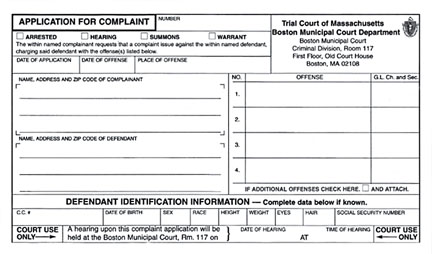
There is a process for the issuance of criminal complaints in Massachusetts that involve misdemeanors where the accused is not under arrest. The law establishing the procedure is Massachusetts General Laws Chapter 218 Section 35A. That law states that the accused shall be given the opportunity to be heard and to oppose the issuance of the complaint. The exception is where there is an imminent threat of bodily injury, flight or the commission of another crime. The Clerk Magistrate conducting the hearing weighs the evidence and makes the determination as to whether probable cause exists to believe that a crime was committed and that the accused is the person who committed the crime. Probable cause is the lowest standard in the criminal legal system in Massachusetts.

These proceedings, commonly known as Clerk's Hearings, are limited in scope and for a complaint to issue either the victim or a police officer simply needs to lay out the allegations. There is no right to cross-examine witnesses at these hearings. Once a criminal application is filed by a civilian in Massachusetts a Clerk Magistrate must act on it. The finding of probable cause does not mean however that the Clerk Magistrate must issue the complaint. The clerk can refuse to issue a complaint. The clerk can hold the issuance of the complaint and afford the parties the opportunity to resolve the case without criminal court action. The clerk can continue the matter for a period of time with the understanding that a complaint will not issue provided the accused stays out of trouble or makes restitution. The function of the Clerk Magistrate in these matters is not only to make probable cause determinations but to screen out nuisance or petty cases to help keep the criminal courts running smoothly. Any Massachusetts Criminal Lawyer will tell you that the Clerk Magistrate Hearing is a wonderful opportunity to resolve a case without judicial intervention. This is where jobs, reputations and a person's liberty can be saved without excessive cost, litigation or embarrassment. Good, experienced clerks know the value of a case and will always work hard to promote justice at its earliest stage. As a matter of fact, a significant number of clerk magistrates in Massachusetts are in fact lawyers and have practiced for years before their appointment.

Continue reading "Clerk's Hearing Set in Newburyport District Court For Firefighter Accused of Assault and Battery" »

Bookmark and Share
February 21, 2013

Another Example of How Social Media Can Help Law Enforcement Solve Crime in Massachusetts

Today's Lawrence Eagle Tribune report by Douglas Moser shows just how powerful a tool Social Media can be to law enforcement and to me as a Massachusetts Criminal Defense Lawyer. Moser wrote about a fight that broke out two nights ago at a basketball game between Methuen and Haverhill. Apparently the catalyst for the incident was texting and tagging following last Saturday's Methuen, Haverhill hockey game. One Haverhill player took credit for hitting a Methuen player during the game. The incident may or may not have happened but nevertheless this person apparently followed up by "tagging" the Methuen student with threats. That same night a Haverhill girl claimed to have been struck by a Methuen girl at that game. Following the game tweets started to fly. Threats of retaliation targeting the Methuen, Haverhill basketball game were tweeted. Haverhill police got wind of the potential for problems and responded by beefing up their presence at the game. Sure enough, as the game progressed the tweeting exchanges intensified culminating in fights behind the school in a parking lot. In all, seven arrests were made. Six of the people arrested were charged with Disorderly Conduct. The seventh defendant was charged with Assault and Battery by Means of a Dangerous Weapon. The cases are pending in the Haverhill District Court.

Read Article:

Haverhill, Massachusetts Assault and Battery Defense Law Firm

Massachusetts Lawyer Who Defends Assault and Battery by Means of a Dangerous Weapon Cases, Disorderly Person

It seems like any time I open a newspaper I read about someone using the Social Media in a manner that lands that person in trouble. This article perfectly illustrates just how stupid aggressive texting can be. Take for instance the Haverhill hockey player who was tagging the Methuen student with threats. That action in and of itself is a crime in Massachusetts known as Threatening to Commit a Crime or Threats. The flurry of threats of retaliation are criminally actionable in Massachusetts as well. I am willing to bet that there are several people attending these schools who have tweeted material constituting an admission to involvement in the fights. That could land them in hot water. People, especially younger people just don't get it. A screen shot of the inculpatory tweets can suffice to launch a criminal investigation. As I have said on numerous occasions, don't put anything in writing. Nothing good comes from it and at times your own written words can spell doom for your criminal case.

So what's going to happen to the defendants in this case? Probably not much if they are properly represented. A dismissal with courts costs, pretrial probation or diversion prior to arraignment are all possibilities. None of this however would have happened had it not been for the nonsense tweeting/texting that followed the hockey game.

Continue reading "Another Example of How Social Media Can Help Law Enforcement Solve Crime in Massachusetts " »

Bookmark and Share
February 12, 2013

Sufficiency of Proof of Serious Bodily Injury in Connection With Crime of Assault and Battery Causing SBI Not Found by Massachusetts Supreme Judicial Court

Last week in Commonwealth v. Scott, the Massachusetts Supreme Judicial Court discussed the concept of Serious Bodily Injury in connection with the crime of Assault and Battery Causing Serious Bodily Injury. See Commonwealth v. Scott.

The facts of the case are as follows:

In 2006 the defendant and the victim had two children together. The couple did not live together. On October 23, 2006 the defendant went to the victim's home. He accused her of seeing someone else. She admitted to doing so. The defendant punched the victim in the face and stomach. Neither that night nor the next day would the defendant permit the victim to leave her home. During that time the beatings continued. Eventually the police were called to the home. The defendant fled. The victim was taken to the hospital where it was determined that, among other things she had sustained a "grade II" lacerated liver. At trial the prosecution advanced the theory that the defendant's punches to the victim's stomach caused the damage to the liver. The district attorney drew authority from Massachusetts General Laws Chapter 265 Section 13(b)(i) which makes it a crime to commit an Assault and Battery that causes Serious Bodily Injury. Under this statute Serious Bodily Injury is defined as causing loss or impairment of an organ. Of applicable significance to Commonwealth v. Scott is the word "impairment". The court reasoned that impairment of an organ, therefore, occurs when damage to the structure of the organ is significant enough to compromise its ability to perform its function in the victim's body." Absent expert testimony explaining the nature and extent of the liver injury, or medical records identifying the same, the jury could not have found, without speculation the presence of this element. The Supreme Judicial Court concluded that the defendant's motion for a required finding of not guilty should have been allowed. The verdict as to this indictment was reversed.

The use of expert witnesses in Massachusetts Criminal Cases is often necessary for the accused to succeed in defending his or her case. Our office has used expert witnesses for all types of criminal cases; OUI cases, Rape, Drug Offenses, Theft Crimes and more. Sometimes experts are used to provide reports that assist a judge in determining how someone who is convicted or pleads guilty should be sentenced. Expert witnesses can educate jurors, corroborate defense theories, counter prosecution experts and help to exclude evidence that should not be presented to a jury. In this case the fact that the Commonwealth's case could not survive without an expert does not mean that their engagement of an expert would have resulted in a successful prosecution. It might have been the other way around. A doctor's testimony might have shown that there was no impairment and just maybe this is why the district attorney did not call an expert to trial.

Continue reading "Sufficiency of Proof of Serious Bodily Injury in Connection With Crime of Assault and Battery Causing SBI Not Found by Massachusetts Supreme Judicial Court" »

Bookmark and Share
February 6, 2013

Brockton Man Arrested in Drug Sweep Indicted for Distribution of Cocaine, Subsequent Offense

Last week a grand jury sitting in Plymouth County charged Mister T. Hood with three counts of Distribution of Cocaine, Subsequent Offense. It is alleged that Hood committed these crimes in mid-December. He was arrested in connection with a massive drug investigation that led to the arrests of over twenty people. Hood's prior convictions are from 2002, 2005 and 2009. Hood's arrest stems from "Operation Clean Sweep". Out of the twenty plus people arrested from that operation only Hood and one other have been indicted. This case will be prosecuted in the Brockton Superior Court.

Read Article:

Brockton, Massachusetts Drug Distribution Law Firm

Lawyers Who Defend Drug Cases in Brockton

Massachusetts General Laws Chapter 94C Section 32A(b) states that anyone who is convicted of distributing cocaine and has one or more prior such convictions shall serve at least a two year state prison sentence. There is a maximum ten year state prison sentence authorized. So assuming this is the statute under which Hood has been indicted you might ask why bring a case like this one to superior court. After all, there are ways to get that kind of time through a conviction in the district court. Well, there could be countless reasons for the indictment but in this case I imagine Hood's criminal history had a significant impact on this decision. Not only does he have three prior convictions but convictions for Massachusetts Violent Crimes (Assault and Battery by Means of a Dangerous Weapon) and, he beat a murder charge. Or perhaps Hood is viewed as the more dominant player in this sweep and the indictment is designed as a deterrent to warn others not to continue with these activities.

As an experienced Massachusetts Criminal Lawyer I have noticed that absent some sort of concrete evidence such as a surveillance videotape jurors do not like to convict people who were not arrested at the time of the offense. The district attorney prosecuting these cases relies on an officer or cooperating person stating what they saw Hood do. Yet, there is no immediate arrest. Rather, they permit him to continue dealing drugs and then, at least in this case, make an arrest eight days later. That does not sit well with jurors. It also enables the accused to establish an alibi or alibis showing that he was nowhere in the area at the time of the alleged criminal activity. Investigations like this are risky and the police rely on getting most of the people who are arrested to plead guilty or cooperate. The article referenced above identifies five people who have already pleaded guilty to the crimes for which they were charged.

Continue reading "Brockton Man Arrested in Drug Sweep Indicted for Distribution of Cocaine, Subsequent Offense" »

Bookmark and Share
January 29, 2013

Massachusetts Man Faces Animal Cruelty, Gun Charges After Shooting Own Dog

Gordon Lagstrom of Middleboro, Massachusetts was arraigned at the Wareham District Court yesterday on charges of Animal Cruelty, Possession of a Firearm While Intoxicated and Discharging a Firearm Within Five Hundred Feet of a Building. According to a report in the Brockton Enterprise, Lagstrom brought his dog to a veterinarian for emergency help after the dog had sustained a gunshot wound. Lagstrom asked for help for the animal. A police officer responded to the veterinary clinic and formed the opinion that Lagstrom had been drinking. After some questioning the defendant admitted to shooting the dog accidentally believing that someone was trying to get into his home. Officers continued to investigate and found a trail of blood starting in the yard, leading to the defendant's home and ending in Lagstrom's living room floor. Officers then found two guns, one loaded and neither properly stored. If indicted, this case will be prosecuted in the Plymouth County Superior Court.

Wareham, Massachusetts Firearm Possession Defense

Massachusetts Gun Crimes Lawyer

The Animal Cruelty statute in Massachusetts is broad. The law, Massachusetts General Laws Chapter 272 Section 77 prohibits the following acts: overworking animals, beating animals, killing animals, starving animals, torturing them, mutilating them and more. A conviction for the commission of this offense carries a possible five year state prison sentence. I have seen many of these cases prosecuted in Massachusetts for the past twenty years. Massachusetts district attorneys take these matters quite seriously and often request jail time for someone found guilty of this crime. At least as suggested in this article Lagstrom will have some problems. He will first have to show that the police officer's theory about where the dog was shot was incorrect. Either that or the defendant will have to adduce facts that support his statement that someone was trying to get into his home when he accidentally shot the dog. The blood trail and forensic evidence, i.e. gunshot residue, location of any shell casings and items of that nature will have to match up with his statement. A firearms expert and/or perhaps a blood spatter expert will be useful if the defendant continues with this defense.

The firearms cases are somewhat different in terms of a defense. Massachusetts General Laws Chapter 269 Section 10H prohibits anyone from carrying a firearm while under the influence of alcohol or drugs. The standard for "under the influence" is the same as for OUI cases. A conviction for this crime carries a potential two and one half year house of correction sentence. This crime is not often prosecuted. As a matter of fact, as of today Lexis shows that there are not reported decisions dealing with this crime.

Continue reading "Massachusetts Man Faces Animal Cruelty, Gun Charges After Shooting Own Dog" »

Bookmark and Share
January 25, 2013

Brockton Man Arrested, Charged With Home Invasion In Plymouth District Court

According to a report in the Brockton Enterprise Paul Perelli met up with defendant Eddy Monteiro, a Brockton, Massachusetts resident at Perelli's home in Marshfield. It is alleged that Monteiro owed Perelli one hundred fifty dollars and wanted to settle the debt. Monteiro and Perelli, along with Michael Capps and Stephen Burton smoked some marijuana together. Shortly thereafter, two unknown men arrived, bound Perelli, Capps and Burton and pistol whipped Capps. Monteiro allegedly participated with them as well. Perelli called the police. When they arrived they found "an elaborate indoor marijuana-growing operation, complete with hydroponic tanks for growing plants". Monteiro was arrested and charged with Home Invasion with a Firearm and several counts of Armed Assault in a Dwelling. His case is pending in the Plymouth District Court. Perelli and/or his friends may have problems as well. The article reports that the police seized two pounds of pot and several thousand dollars cash.

Read Article:

Plymouth Home Invasion Defense Law Firm

Brockton Violent Crimes Defense Lawyer, Gun Cases, Marijuana Distribution

Any Massachusetts Criminal Lawyer reading this article is going to ask why Perelli called the cops. Either Perelli, Capps or Burton or perhaps all three have exposure for Cultivating Marijuana or Possession With the Intent to Distribute stemming from their marijuana growing operation. The penalty for a conviction of these Massachusetts Marijuana Crimes pales in comparison to the sentence Monteiro and his cohorts face if convicted of the Home Invasion. Yet you have to wonder why Perelli made the call. Was this in fact the drug rip that is portrayed in this article? Or was this a drug deal that went bad? On several occasions I have defended cases that look at the outset like the accused was trying to rob a known dealer. However every time these cases get more closely investigate I learn that not to be the case. There is usually some sort of mutual dispute that escalates. Someone then tries to get the upper hand by making an accusation about something like a Home Invasion. The person making the report wants the police to believe that he is the victim and does what he can to get that person in custody as a way of getting out of the dispute. This tactic doesn't always work. An experience criminal lawyer can expose the false accusation. Text conversations between Monteiro and Perelli can shed some light on what really happened here as can text messages between Monteiro and has unidentified "friends". Perhaps these people too had memorialized conversations with Perelli thereby suggesting that they were not unknown to him. All of this will rear its head during the discovery process and might serve Monteiro's defense well.

Continue reading "Brockton Man Arrested, Charged With Home Invasion In Plymouth District Court" »

Bookmark and Share
January 15, 2013

Lawrence, Massachusetts Police Make Arrest For Intimidation of a Witness at a Murder Trial

Jose Davilla of Lawrence, Massachusetts was arrested yesterday at his home. He has been charged with Intimidation of a Witness. They are still looking for Rafael Rodriguez, also being charged with the same felony offense. It is alleged that the accused posted the photos of two witnesses to a murder case through the social media Instagram and attaching to their pictures the word "snitch". The pictures were posted on Rodriguez and Davilla's accounts. The defendants were friends of Jose Ruiz, the defendant in a murder case that concluded in the Essex County Superior Court yesterday. Right now this case is being handled in the Lawrence District Court.

Read Article:

Massachusetts Criminal Defense Law Firm, Intimidation of a Witness Charges

Lawrence, Massachusetts Criminal Lawyer, Violent Crimes, Felonies

The crime of Intimidation of a Witness is Massachusetts is set out in Massachusetts General Laws Chapter 268 Section 13B. As you might expect, the law makes it a crime to in any way threaten a witness or someone who has information about a criminal case in Massachusetts. This crime is a felony. Anyone convicted of this offense can be punished by up to tow and one half years in the house of correction or up to ten years in state prison. A fine of up to five thousand dollars might also be imposed. These cases can be prosecuted in either the county where the defendant committed the act or in the county where the criminal proceeding is taking place.

These cases are getting prosecuted much more frequently these days than they had been in the past. This is largely due to social media such as Facebook, Twitter, texting and now Instagram. It is all too easy to trace the origin of threatening messages. In addition to being illegal, using the social media for such conduct is downright stupid. It is basically like sending a signed letter in your own handwriting. This is however often the best defense to cases like this one. An experienced Massachusetts Criminal Lawyer might ask the jury to consider whether it was the defendant who posted the message or someone else. People often have access to other people's media devices. Desktop computers, laptops, smartphones and ipads all have the capability of transmitting this material. People share these devices regularly and absent some additional evidence the mere publishing of intimidating words or photos does not mean that the owner of the sending device is guilty. If the defendant in this case did not admit to this act then perhaps he has a viable defense to these charges. Regardless, the one lesson anyone should take from stories like this is "Don't put anything in writing". That action, like talking to the police, can only worsen the problems that you might be facing.

Continue reading "Lawrence, Massachusetts Police Make Arrest For Intimidation of a Witness at a Murder Trial" »

Bookmark and Share
January 4, 2013

Taunton Massachusetts Woman Charged With Perjury, Intimidation of a Witness After Lying to Brockton Grand Jury

Today's Brockton Enterprise reports that Patrice Moorer, a Taunton, Massachusetts woman has been indicted on allegations that she lied to a Plymouth County Grand Jury in a Murder Case. The alleged misleading information provided by Moorer relates back to a November 2009 murder in Brockton. In the early morning hours four people were shot at a Hess Gas Station. One of the victims succumbed to his wounds. A day after the shooting Moorer was interviewed by the police and summonsed to testify before a grand jury. She provided testimony at that proceeding. Subsequently, in 2010, Moorer spoke with state police again. This past September she was again summonsed to testify before the grand jury. She did only this time her testimony changed. Authorities then charged Moorer with Perjury and Intimidation of a Witness. Her case is pending in the Brockton Superior Court.

Read Article:

Brockton, Massachusetts Violent Crime Defense Law Firm

Massachusetts Criminal Defense Lawyer, Perjury, Intimidation of a Witness

The Massachusetts Witness Intimidation statute, M.G.L. c. 268 Section 13B includes what is commonly known as the crime of Obstruction of Justice. Among other things this statute makes it a crime for anyone to lie to a police officer who is investigating a case or to lie to a grand jury. This crime is a felony. It is punishable by up to ten years in state prison and a five thousand dollar fine. It is not clear from this article whether the basis for the charges against Moorer stem from allegations that she lied to the state police investigating the murder or lies to the grand jury or both. What is clear however is that she has some tremendous exposure.

As a Massachusetts Criminal Lawyer I see cases like this one becoming more prevalent. District attorneys now indict this conduct more frequently. They do so for several reasons. They want to send a message to people that misleading an investigation, particularly one of this magnitude will not be tolerated. Perhaps more importantly these cases get filed to "squeeze" the witness into providing more accurate information regarding their knowledge of the crime. I would imagine that law enforcement believes that Moorer has some significant knowledge either of the events or people who might have been involved in the crime. The threat of ten years in jail looming over her might be incentive enough for her to cooperate in exchange for some sort of leniency in her pending case. This again however is a perfect example of how speaking to the police without hiring a lawyer can get you into big trouble. Always err on the side of caution and consult with a lawyer before talking to the police. Some basic advice can save you the problems that Moorer is facing.

Continue reading "Taunton Massachusetts Woman Charged With Perjury, Intimidation of a Witness After Lying to Brockton Grand Jury " »

Bookmark and Share
January 3, 2013

Brockton Man Indicted for Home Invasion, Kidnapping Identified by 13 Year Old Victim

According to a report in the Brockton Enterprise, Dery Moeda of Brockton, Massachusetts has been indicted by a Plymouth County grand jury for Home Invasion and related Massachusetts Violent Crimes. It is alleged that Moeda broke into a home on October 11, 2012 around 7:30 in the morning. While in the home he placed a gun against a thirteen year old girl's head, telling her to remain silent while the apartment in which she lived was searched for nearly one hour. Apparently Moeda and his cohorts were looking for money they believed to be in the home. The girl identified Moeda through a photo array. In addition to Home Invasion, Moeda has been charged with Kidnapping and Larceny Over $250. The case is being prosecuted in the Brockton Superior Court.

Read Article:

Plymouth County Kidnapping Defense Law Firm

Brockton Criminal Defense Lawyer, Home Invasion, Larceny

Whenever a Massachusetts Criminal Lawyer defends a case like this one the photographic identification process gets scrutinized. I always want to know what the victim saw and how strong her identification of the suspect was prior to her being presented with the photographic array. The identification itself and the photographic array get introduced into evidence unless the defendant's lawyer is able to show that this aspect of the identification process was unnecessarily suggestive and that the identification itself was tainted because of it. The burden is on the defendant to show by a preponderance of the evidence that given the totality of the circumstances the identification process was so "suggestive and conducive to irreparable misidentification as to deny the defendant due process of law". While this task is difficult and arguably unconstitutional given its burden shifting application, recently the Massachusetts Supreme Judicial Court established an advisory protocol to help ensure against abuse. This would require law enforcement to make it clear to the witness that the person who committed the crime may or may not be in the array. The witness should also be advised that it is just as important to clear someone as it is to identify someone. Additionally, the witness should be told that the individuals depicted in the photographs might appear different than they did at the time of the crime and that regardless of whether or not an identification is made the investigation will continue. The procedure shall also ask the person making the identification to state the degree of certainty he has in selecting the photo.

When this procedure is not used in accordance with the Supreme Judicial Court's recommendation I usually ask the trial judge to incorporate in the jury instructions language that reflects law enforcement's failure. I view a significant percentage of out of court photographic identifications as unreliable and suggestive. This is certainly something worth litigating in Massachusetts Criminal Cases.

Continue reading "Brockton Man Indicted for Home Invasion, Kidnapping Identified by 13 Year Old Victim" »

Bookmark and Share
December 19, 2012

Massachusetts Man Facing Attempted Murder Charges in Westborough District Court May Have Been Acting in Self-Defense

According to a report in the Metrowest Daily News, Donald Williams, a fifty six year old Massachusetts man is being charged with Attempted Murder. It is alleged that late last week police were called to a Worcester County address where they encountered Williams in the garage. Williams told the officers that the "victim" had attacked him with a baseball bat. In response, Williams stabbed the man. The home to which the police responded belonged to neither of the combatants. Williams was initially charged with Assault and Battery, Assault and Battery by Means of a Dangerous Weapon, the same charged alleging the additional element of serious bodily injury and Assault. The charges were amended to add Attempted Murder. The case will likely be prosecuted in the Worcester Superior Court. Bail was set in the amount of five thousand dollars. The "victim", a man named John Cortez is also being charged with a Violent Crime, specifically Assault and Assault and Battery With a Dangerous Weapon.

Read Article:

Worcester County Assault and Battery Defense Law Firm

Lawyers Who Defend Crimes in Worcester Courts

As a Massachusetts Criminal Lawyer two things dart out at me when reading this article. One is the defense of self-defense. The other is the issue of the mutual invocation of Fifth Amendment privileges.

Self-Defense

Here are some things to consider when evaluating self-defense as a means of defending charges like these. The prosecution must prove beyond a reasonable doubt that Williams did not act in self-defense. To do this the district attorney must show that the defendant did not reasonably believe that he was being attacked or was about to be attacked and that and that he was in danger of great bodily harm or death. The prosecutor must also prove beyond a reasonable doubt that Williams did everything reasonable to avoid the fight. Finally the prosecutor must prove beyond a reasonable doubt that the force Williams used was not reasonably necessary. This might be a difficult obstacle for the prosecutor to overcome. Williams was attacked by Cortez. The article suggests that he was permissibly at the location where the fight occurred. It is unclear whether Cortez was there with the homeowner's consent. Cortez also used a baseball bat to strike Williams. Williams may not have been able to avoid defending himself and perhaps the only way he could do so was with a weapon. Also keep in mind that Williams never fled the crimes scene. This is evidence that works in his favor. Similarly, if Williams called the police the suggestion that he was the victim rather than the aggressor might prevail. The question is what would a reasonable person sitting in Williams' shoes do? Massachusetts law states that retaliation is not a defense so the timing of the stabbing vis a vis the attack with the baseball bat becomes important here.

Fifth Amendment Privileges

Anytime someone does something that can be construed as being criminal he has the right to invoke his Fifth Amendment Privilege and refuse to testify. Oftentimes fights never get prosecuted as a result of this right. People who get charged with committing a crime either hire a lawyer or get a lawyer appointed for them. In situations like this one, where both combatants are charged with crimes of violence both will have a lawyer. An Experienced Massachusetts Criminal Lawyer will probably tell his client to invoke the privilege and remain silent. In other words, the person will not testify against the person against whom he fought. Absent an independent witnsess' the case will likely get dismissed.

Continue reading "Massachusetts Man Facing Attempted Murder Charges in Westborough District Court May Have Been Acting in Self-Defense" »

Bookmark and Share
December 4, 2012

Massachusetts Couple Arrested After Road Rage Incident, Charged With Assault and Battery In Newburyport District Court

William Kotowski and his wife Joanna were driving home in separate cars after meeting for dinner late last week. Another car being driven by an unnamed individual was being operated in an aggressive manner, one that appeared threatening to the Kotowski's. That man pulled off of the road to enter and establishment. William Kotowski followed the man into the parking lot. While he was in his car the other man approached him and started to scream at Kotowski. This individual claims that Kotowski then brandished a firearm, pointing it at his face. Kotowski then left. The police arrived at his home, conducted a search and found the Firearm. Joanna Kotowski arrived home during the arrest. Incensed at the fact that the other person was not arrested she went back to the store to confront the man. She too was then arrested. William Kotowski has been charged with Assault and Battery by Means of a Dangerous Weapon and a Massachusetts Firearms Crime. Joanna Kotowski has been charged with Assault and Battery and Disorderly Conduct. The case is pending in the Newburyport District Court.

Read Article:

Massachusetts Assault and Battery With a Dangerous Weapons Defense Law Firm

Newburyport, Massachusetts Assault and Battery Lawyer, Gun Charges Attorney

The best way to see what might have happened in the parking lot is to check for security video cameras. More and more establishments have installed some sort of security device over the past decade. The cost of installation is cheap. Parking lots and entryways to today's establishments often have this equipment to prevent thefts and to identify suspicious patrons. A diligent Massachusetts Criminal Lawyer will usually visit the crime scene on his case to see what evidence might exist to help exonerate his client. One such piece of evidence is the presence of video equipment. I recently had a Drunk Driving (OUI) case in a Middlesex County Court where the police officer failed to secure a videotape of the parking lot at a convenience store where he supposedly had the defendant perform Field Sobriety Tests. During cross-examination the officer was shown pictures of the structure, the parking lot and the cameras. He was asked whether or not efforts were made to secure the videotape. His answers were evasive. It was clear to the jury that the officer was either lying or that he did not adequately do his job. This resulted in a successful outcome for my client. A videotape might support Kotowski's defense that the "victim" was the initial aggressor in this case.

The Kotowski's complaint about the victim not being arrested is a valid one. However, not all is lost simply because this person was not arrested. The defendant's can certainly apply for a complaint against this person at the courthouse if they feel aggrieved.

Continue reading "Massachusetts Couple Arrested After Road Rage Incident, Charged With Assault and Battery In Newburyport District Court" »

Bookmark and Share